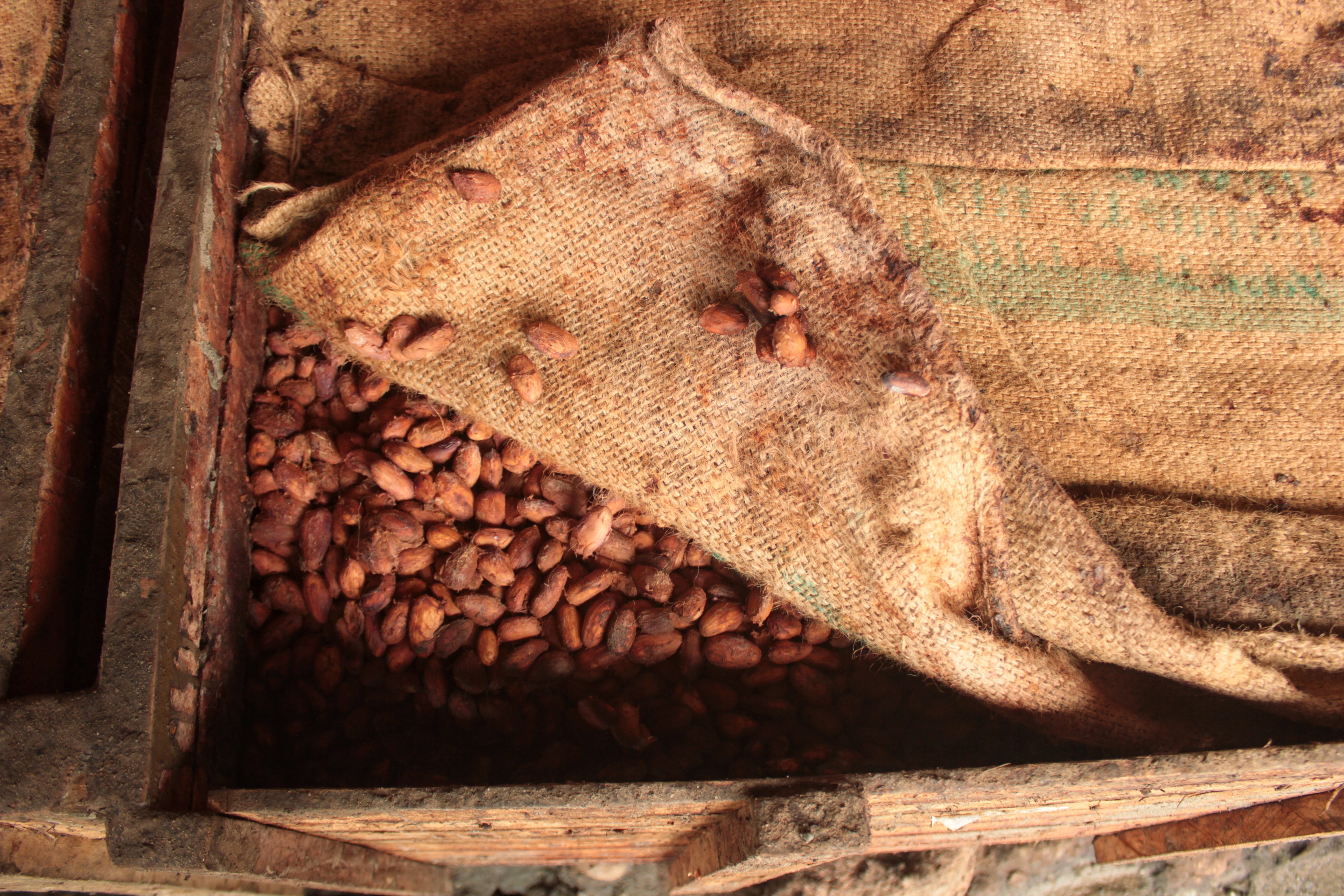
The U.S. Supreme Court decided today that 6 former child slaves who were kidnapped at a bus station in Mali, driven across the border to the Ivory Coast, then sold to farmers for $40 apiece to harvest cocoa beans had no grounds to bring a lawsuit against Nestle for human rights violations. The claim was that Nestle and others “aided and abetted” these human rights violations by buying these beans that they knew were low cost and tainted by enslaved children.
The U.S. Department of Labor estimates that there are 1.58 million children working harvesting cocoa beans in Ghana and Ivory Coast where Nestle, Cargill, Hershey, Mars, Barry Callebaut and others get most of their beans. They estimate that 48% of them are performing “hazardous labor.” Rest assured that this is not your grandparents family farm situation when you might have helped them bail hay, break ice, or deliver a calf. This is brutal, inhumane and sad.
The children in today’s case were tortured and treated like animals. Let’s look directly at the brief they filed in the Supreme Court:
Respondents are six former child slaves who were trafficked from Mali and subsequently held for years in slavery on Ivorian cocoa plantations. Between the ages of twelve and fourteen Respondents were forced to work on Ivorian cocoa farms for twelve to fourteen hours per day, at least six days per week. They were not paid and were given only scraps of food to eat. Respondents were beaten with whips and tree branches when their overseers felt that they were not working quickly enough. They were forced to sleep on dirt floors in small, locked shacks with other children, and were guarded by men with guns to prevent them from escaping. Respondents witnessed other children who tried to flee the plantations being severely beaten and 4 tortured. One Respondent, John Doe IV, tried to escape, and when the overseers caught him, they cut the bottoms of his feet and rubbed chili pepper into his wounds. He was also tied to a tree and beaten until his arm was permanently damaged. John Doe III witnessed small children who tried to escape being forced to drink urine. John Doe VI was severely beaten for working too slowly when he was sick and, like the other Respondents, his arms bear multiple scars from machete cuts he incurred while being forced to use the sharp tool to cut down and open cocoa pods.
I’d like you to read that paragraph again and let it sink in. Nestle responded to this lawsuit when it was filed in 2005 and have been blocking these children from their day in court for 16 years. They won today. This means that their human rights lawyer – Terry Collingsworth – has not been able to present any evidence, no jury, no discovery, no chance for the children to be heard. Terry founded and runs the non-profit law firm International Rights Advocates fighting the fight against these abuses. It is David v Goliath IRL. Terry is a hero and selfless advocate who is not letting this ruling slow down his work on behalf of his clients.
The sad headline is this: the highest court in our land said that cheap chocolate made on the backs of child slaves will remain cheap for now. I say “for now” because the complicated and divided opinion left the door open a tiny crack that the plaintiff children can amend their charges in the U.S. District Court in California and maybe just maybe have a cause of action that will pass Supreme Court muster. It’s not over.
Why did the Supremes reverse this case and hand Nestle a temporary child slave permit? This gets complicated even for me and I spent nearly 20 years in the courtroom and getting ready for trials as a criminal defense lawyer. I spent a short lifetime reading Supreme Court cases and doing my best to interpret their meaning and impact. Justice Thomas said that the former child slaves did not adequately allege that Nestle’s conduct was inside the United States. Speaking for the Court he also said (and here’s where it might be argued otherwise) that there is not a cause of action at all under the Alien Tort Statute which is the anchor for these plaintiffs. The New York Times, less biased than me, did a nice job of explaining it. For a deeper dive check out this well respected blog on all things Supreme Court.
What do we have to do with this you ask? You might recall from other posts that Askinosie Chocolate, along with 17 other small chocolate companies, filed an Amicus Brief in the Supreme Court last year supporting the rights of these child slaves to have their day in court. Our lawyers at Corporate Accountability Lab argued that there are other ways to make chocolate without using slaves. The best background primer on this litigation and the issue itself is this article by journalist Simran Sethi in The Counter from last week. Chocolate industry expert Clay Gordon interviewed me last week, before the case was decided, but it’s a good conversation if you’re interested in checking it out. We’ve been on this issue for years and will continue to advocate for children and tell our story. I wrote an extensive post when the Washington Post broke the story 2 years ago about the pervasive problem in the chocolate industry.
What’s next? Another lawsuit was filed this past February in federal court on behalf of other former slaves under a different statute. I think this has a great chance of success. There is another case pending in front of the Customs and Border Protection agency asking that they not allow cocoa beans in this country that have been harvested by child slaves. Stay tuned. In the meantime, we will keep working with farmers directly, profit sharing, paying way above farmgate price and engaging in their communities. They are our friends.
My call to action: please consider donating to the International Rights Advocates, a 501(c)(3) human rights law firm run by Terry Collingsworth so they can keep fighting this important fight. And for those of you who know me, I am not letting this go and will do everything I possibly can in my chocolate making lawyer powers to help Terry stop Big Chocolate from using enslaved children. And of course when it comes to our chocolate, we’ll keep living what you’ve come to expect from us because remember, it’s not about the chocolate, it’s about the chocolate.
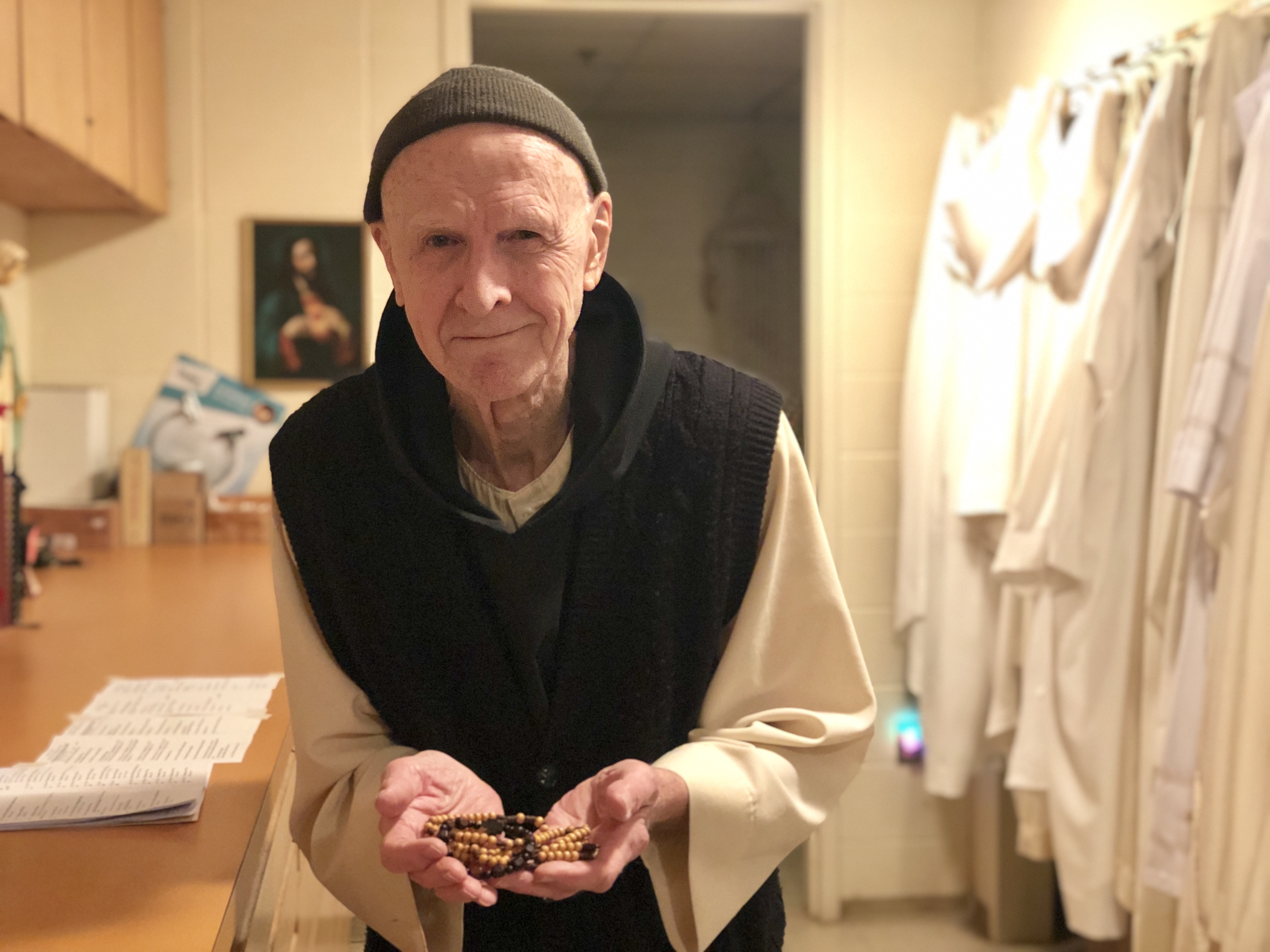
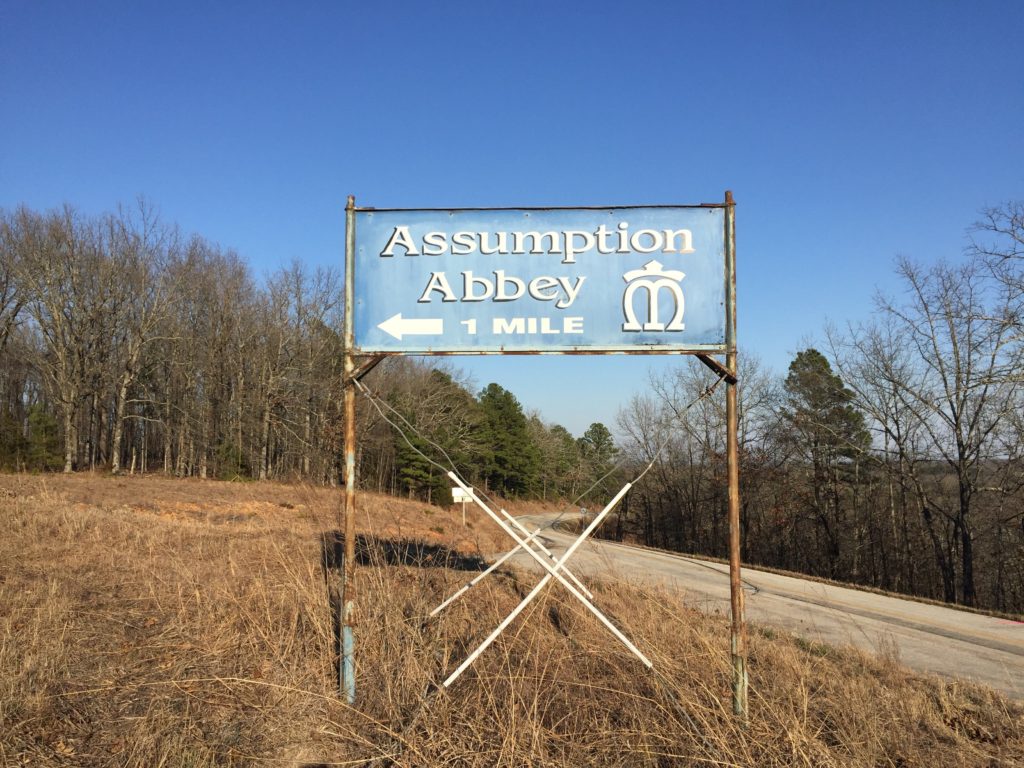
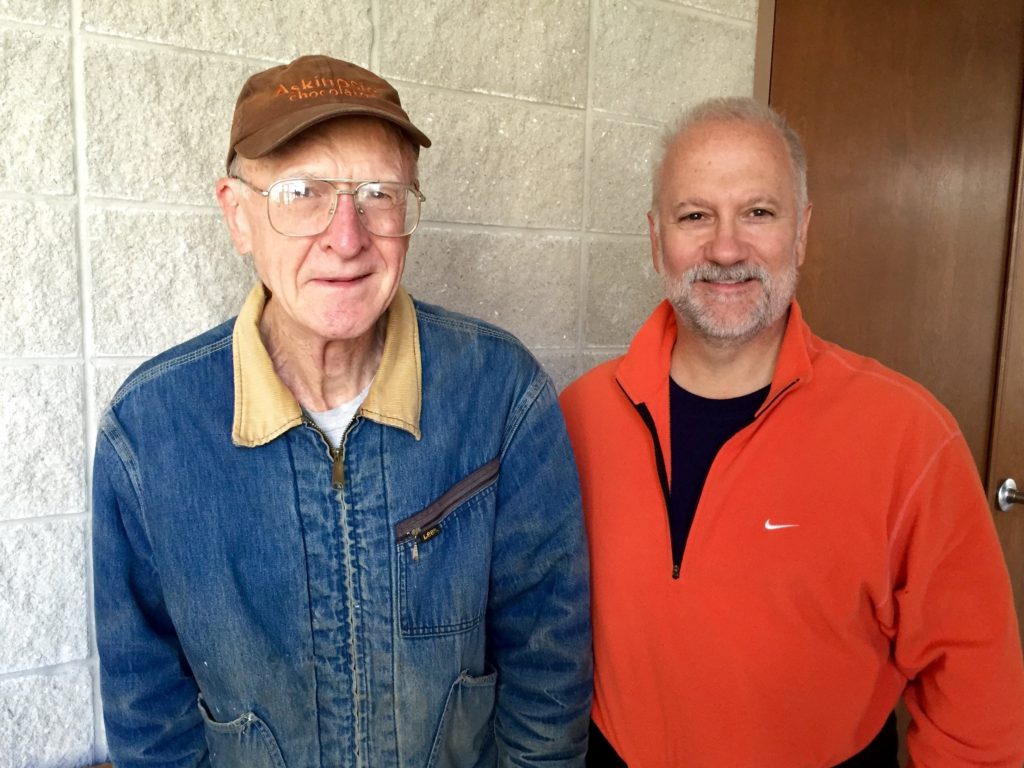
Just kidding. I am not sure Father Cyprian has ever walked into a bar; not that he wouldn’t but I don’t think he has. I’ve been walking the country roads near Assumption Abby, in the Mark Twain National Forrest, with him for over twenty years. This Trappist Monk has been my spiritual director all that time. I was telling my therapist this week, yes I have one of those too, that I’ve journaled every visit to the abbey from lawyer to chocolate maker and everything in between. And the funny (not funny) thing is that when I reviewed old entries from long ago I see where not much has changed in my struggles. But then if I really look I also notice tiny little insights that have evolved into change. Cyprian entered New Melleray Abbey in Iowa in 1950 and was among the first monks to establish monastic life at Assumption Abbey near Ava, Missouri where they now make famous fruitcakes to support their way of life. Part of this conversation I had with Father Cyprian originally appeared in The New Territory magazine’s “Shop Talk” series this past summer. I’ve been in the company of many people around the world in my life but I am hard pressed to name another person in whose presence I’ve felt more wisdom, peace, and grace than Father Cyprian. I have made a lifetime vow to the abbey as a family brother, will one day be buried there, and look forward to the day when I can visit again and become part of the rhythm of community life in solitude.
Father Cyprian: Hello, this is Father Cyprian.
Shawn Askinosie: Father Cyprian, it’s Shawn.
FC: Good morning.
SA: Good morning. Is this still an okay time?
FC: Yeah, it is. It’s fine. We have a nice, drizzly day here.
SA: Yes. In fact, it’s kind of stormy here.
SA: Can you describe for someone who’s never been to Assumption Abbey, the place where you live?
FC: Well, we’re in a very scenic location, hills and hollers, wooded. And for people who are used to solitude or who’ve grown up in the country, they feel at home. For people who are mostly living in cities and the hustle and bustle of the fast life, it can be kind of spooky for a while until they get used to it.
SA: Why do you think that is?
FC: Well, people are different. People have different gifts of nature and grace. And partly, there’s a difference between solitude and loneliness. Solitude can be alone with God, and loneliness can be stuck alone with ourselves without God. All of that would go into the mix of a person’s first reactions and then gradually seeing if they really are at peace or at home at such a location.
SA: What a perfect time to be talking about solitude in the middle of this pandemic because people have been basically put in mandatory solitude.
FC: Right—
SA: … or loneliness whether they like it or not. Would you have any advice for someone who might be struggling with how to accept solitude as a grace? Any suggestions?
FC: Well, I think that you put it right that if we can see a forced solitude as a grace, a gift, and then it can become fruitful. But if it’s something imposed on us that we don’t want to do or don’t want to accept or don’t try to accept, it can be harmful.
SA: Well, speaking of solitude… And I’ve never asked you this before. I’ve asked you a lot of questions in 20 years. And I’ve been thinking about it, it’s been just slightly over 20 years that we’ve been walking around the grounds of the Mark Twain National Forest together. But I haven’t ever asked you, if you could take only one book into solitude if you were going on a really long retreat or to a hermitage (and that book, let’s say for the sake of our discussion is not the Bible or not the Breviary) what do you think that book would be?
FC: Well, you took the book away from me by saying not the scriptures. But I would take a book by Dom Columba Marmion. It’s called Christ in His Mysteries.
SA: Is that a new book or an old book?
FC: No, it’s kind of a golden oldie. It follows God’s plan of creation, salvation according to the liturgical year. It’s geared towards a personal relationship with Christ and union with God.
SA: In living this life, I’m sure that you’ve learned over the years how to live in community with family, with your brothers as friends and family and all of it. So could you maybe say something that you’ve learned, or one or two things that you’ve learned, from when you were 20 to now that as you reflect back, that maybe this is what you’ve learned about how to live in community and how to do that and have stability in this community? What do you think?
FC: Well, we learn early on that we are all essentially in the same boat. We’re all fallen children of Adam and Eve. And the paradox is that we’re also filled with the Spirit of Christ, the Holy Spirit. So there’s that strange combination, paradox of strengths and weaknesses of goodness and woundedness. It gives a trust and it also requires a real trust in God’s presence and work in our community life. Also if you come to appreciate that with all the differences and challenges or whatnot, it is a real blessing to living within a community where there’s this constant current of life, of value, of essential unity that keeps pulling you in the right direction.
SA: Which direction would that be then?
FC: Well, I look on life as a journey of return to the Father, which is pretty much the way our Lord expressed his own life direction. He had that sense that He came forth from the Father into the world. So He was passing through the world on a journey of return to the Father. So that sense that we do come from God’s creating hand and we’re on this life journey.
SA: One of the things that I wanted to talk about in our remaining time is this notion of the Paschal mystery. And I remember when we first started talking, and you started spiritually directing me informally 20 years ago. And I was really struggling then with some health issues and depression, and you introduced me to this concept of the Paschal mystery. And I really, over the last 20 years, deepened my appreciation of that idea, that notion of that doctrine and its application to life. Can you explain a little bit about what the Paschal mystery is and why, in your opinion, it seemed to really resonate with me and perhaps other lay people that you’ve talked to over the years who might be struggling? Why does there seem to be such beauty in this idea of the Paschal mystery?
FC: Well, given the way you presented why does it connect or resonate with our human life, one way would be to say that it’s the way our Lord Jesus dealt with suffering. And that’s such a reality in every human life and greater or lesser, different forms. And there is always that challenge and mystery of suffering, and this is the way He dealt with it in His human life as a Son of Man, Son of God. So it’s He accepted it again to the shadow side of suffering, and He accepted it as part of God the Father, Creator’s plan and way of creation, salvation. He gave it value by seeing it or offering it as a reparation for sin, to make amends for the offenses against the Divine Majesty as a way of showing us, children of Adam of Eve and then adopted children of God, how we can find value and cope with suffering. It’s in identifying, in our own small way, with His own suffering and death, passion of His redeeming sacrifice.
FC: And then also identifying with His resurrection, the glory, the victory, which He brought out of His way of dealing with suffering and death. So that gives us that value of walking through the shadow side, the valley of shadow of death, and then entering also into the glory side, the fruit, the victory of good over evil. As I once said, we don’t fear those reasons that would kill the body but we live in the reverence of God who can bring eternal life out of suffering and death.
SA: Well, it sounds like it applies to the scripture reading I just mentioned for today, Jesus said, “So now you’re in anguish, but I’ll see you and your hearts will rejoice. And nobody will be able to take away that joy.” That’s kind of what we’re talking about, isn’t it?
FC: Right. And then He used such ingenuity in His parables that He used a woman, a mother and her childbirth experience, that fits so perfectly.
SA: We kind of skipped over… or I did by asking you about the Paschal mystery, so in a sentence, what is the Paschal mystery and why that word? What does it mean? What is that?
FC: It would be our Lord Jesus’ passion and death, and His resurrection and ascension and sending the Holy Spirit as the fruit of His own passion and death, resurrection. So it’s sharing that with us through His indwelling Holy Spirit.
SA: A person could literally spend a lifetime meditating, praying, reading, lectio divina about this Paschal mystery.
FC: Yeah. The thing is, that’s what I meant about the growing interest and lectio divina of scripture, it’s not a head trip. It’s something that we live out in real life, daily.
SA: Whenever I talk to see you and I say, “How’s it going?” You routinely say, “I’m flourishing.” I wrote about this in Meaningful Work. What do you mean by that?
FC: That in a sense I took that risk of jumping off the end of the world, seeking the gift of the obedience of faith.
SA: And that’s what you mean by flourishing?
FC: Yeah. There is a gift of faith God gives, a deep inner conviction that this is true and right. Jesus Christ’s way is the right way. He is true. And you take the risk of, again, living it out. And then more and more, over the long run, there’s fruit. You see, it works. It’s real.
FC: So as I get older, I moderate that flourishing. I say, “I’m relatively flourishing.”
SA: As you return home on that journey, I understand.
FC: Okay, right on.
SA: There are some days where I can say I’m flourishing, but there are also other days that I don’t feel like that. You’ve been walking that walk with me, and I was thinking last night that I’ve talked with you about every major decision that I’ve made in my life in the last 20 years. That spiritual direction has been one of the great constants in my life. And so I’m thinking when you do return home and I’m here, and I can’t talk to you like I’m talking to you now, what am I going to do?
FC: God will provide. It isn’t a person that’s kind of a super guru. It’s when we seek spiritual direction from another, we’re really going in the light of faith. We’re talking and seeking God’s will in a person who, in a very real way, represents Christ. Well, that’s part of the mystery and the wonder of the incarnation, that God comes to us through our human nature.
SA: Okay. I will believe that. Well, those were the questions that I wanted to ask. I guess I didn’t ask all of the questions that I said that I was going to, but these are great. And so I will keep you posted on this and-
FC: There’s one more thing that gave me pause to think about in those questions originally. I don’t know whether you want to include it in the article or not but-
SA: Yes, yes, go ahead.
FC: … we’ll talk later about it and you can decide. You said, “What about contemplation?” And I remembered an answer that I was a young monk, my father master or the spiritual director at the time, he was very interested in contemplative prayer. And so at one point he asked me, “Keep some notes of your prayer, let’s say for the next week. And I’ll go over them.” So he did, he read what I had written down. He read it and he kind of shook his head, and he says, “Well now, you don’t have the gift. You’re not the type.” Not in that sense experiencing an approach to prayer which is a contemplative prayer, my own way approach is in terms of contemplative life, seeing every person, everything that happens in the light of faith. And seeing God’s hand at work in the events in people’s lives, short term, long term.
FC: And then as I get older, I become more limited in what I can do and all that. And so exploring it, I read not too long ago about a professional ball player. He’d been in the minor leagues, did really fine, so they sent him up to the majors. After a year or two, it really wasn’t working out. So they said to him, “Well, now what are you going to do?” He says, “Well, I’ll just go back and keep playing. I love the game.” And I thought, well, that fits me nicely. Only for us of course, the game is not something, it’s someone.
That’s all I had on my mind.
SA: No, that’s good. I love that. Thank you Father Cyprian. I really, really appreciate it. And thanks so much for being willing to do this, and thank you for being in my life. And I hope that you’ve been able to have the person in your life when you were “growing up” spiritually that helped you the way you’ve helped me.
FC: Yeah. Actually this very long struggle of gaining the goal of the faith, the gift of obedience of faith, and then the challenges in growing through the years. There’s been a few priests, monks who have served very much that role for me. And God will provide because He’s got the right person at the right time for what you want to do and accomplish.
SA: Yeah, maybe I can help be that person for someone, too. Maybe-
FC: I believe very much in Lost & Found and Chocolate University and also in your family, especially first of all in your family. Oh, say, also —
SA: Yes-
FC: Don’t send me any of this. I don’t need to read it.
SA: Oh, I thought you were going to say, “Don’t send me the chocolate-covered cherries.” And I was going to say, “Too late, I’ve already done that.”
FC: Don’t forget that.
SA: Yeah. No, I did it. I did it the next day after we spoke. I sent it, so you should be receiving that shortly, and please tell me what you think.
FC: Okay, will do.
SA: All right. Thank you so much, Father Cyprian. God be with you.
Mama Mpoki, Chairwoman of the Mababu CCF Cooperative and Askinosie Chocolate Partner
The crisis is physical, emotional, spiritual, financial, political and existential. It’s individual and collective. There’s a kind of unsettling dissonance in these feelings like being in the trough of massive ocean swells buffeting us about daily without the ability to even see the crests. At least that’s how I feel much of these days.
There’s been a lot blogged, memed, posted, and YouTubed in the past two months about fear. Do this, don’t do that, read this, breathe like this or take this pill to diminish your fear. The sheer volume of wellness strategies can be overwhelming.
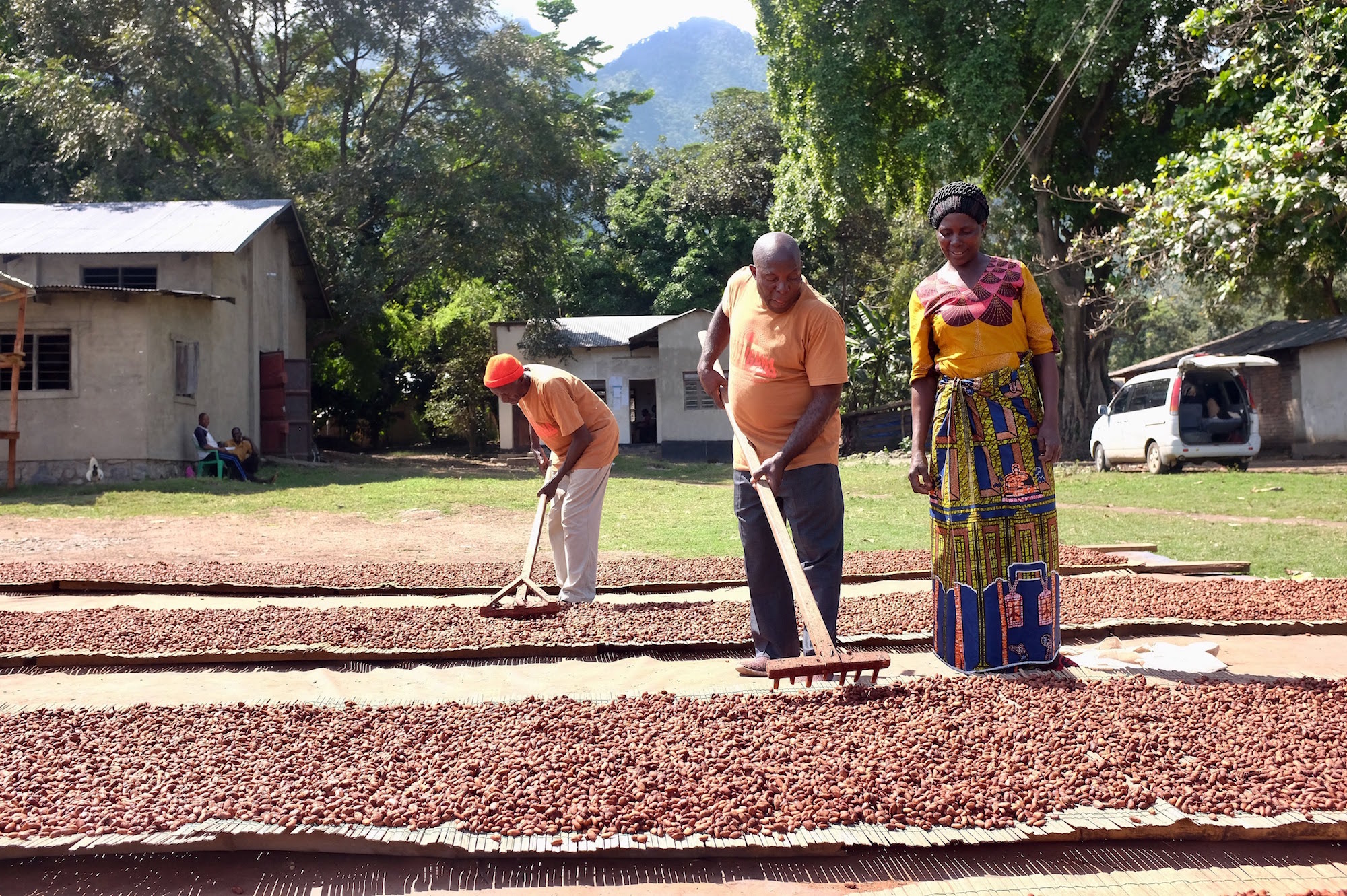
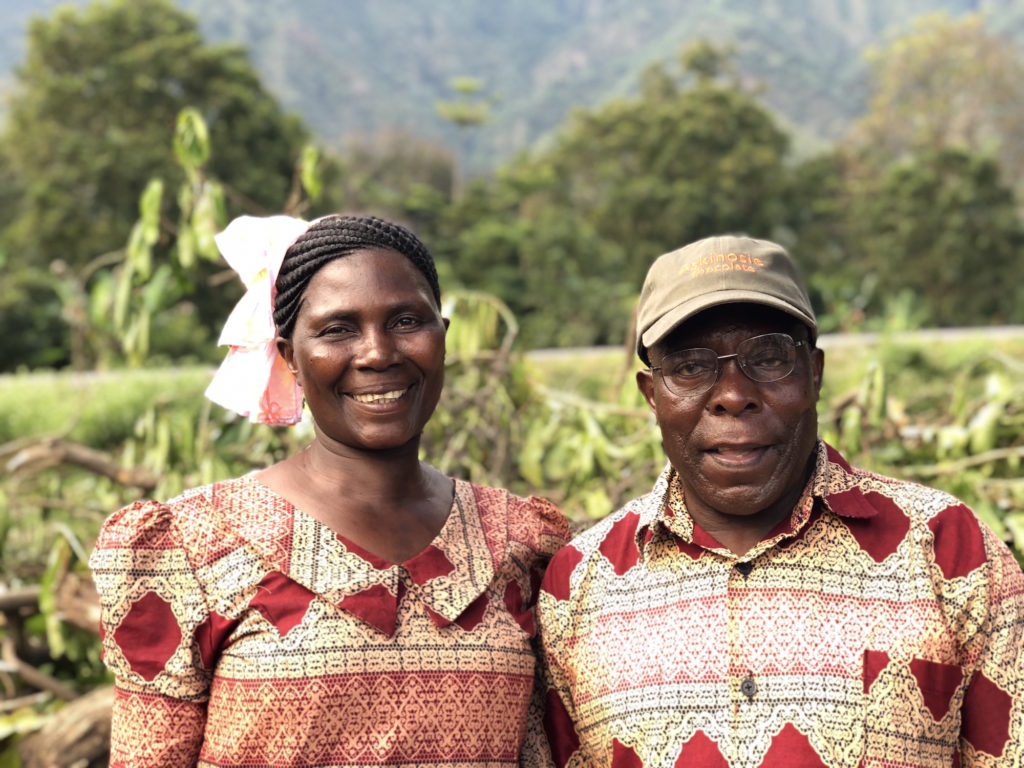
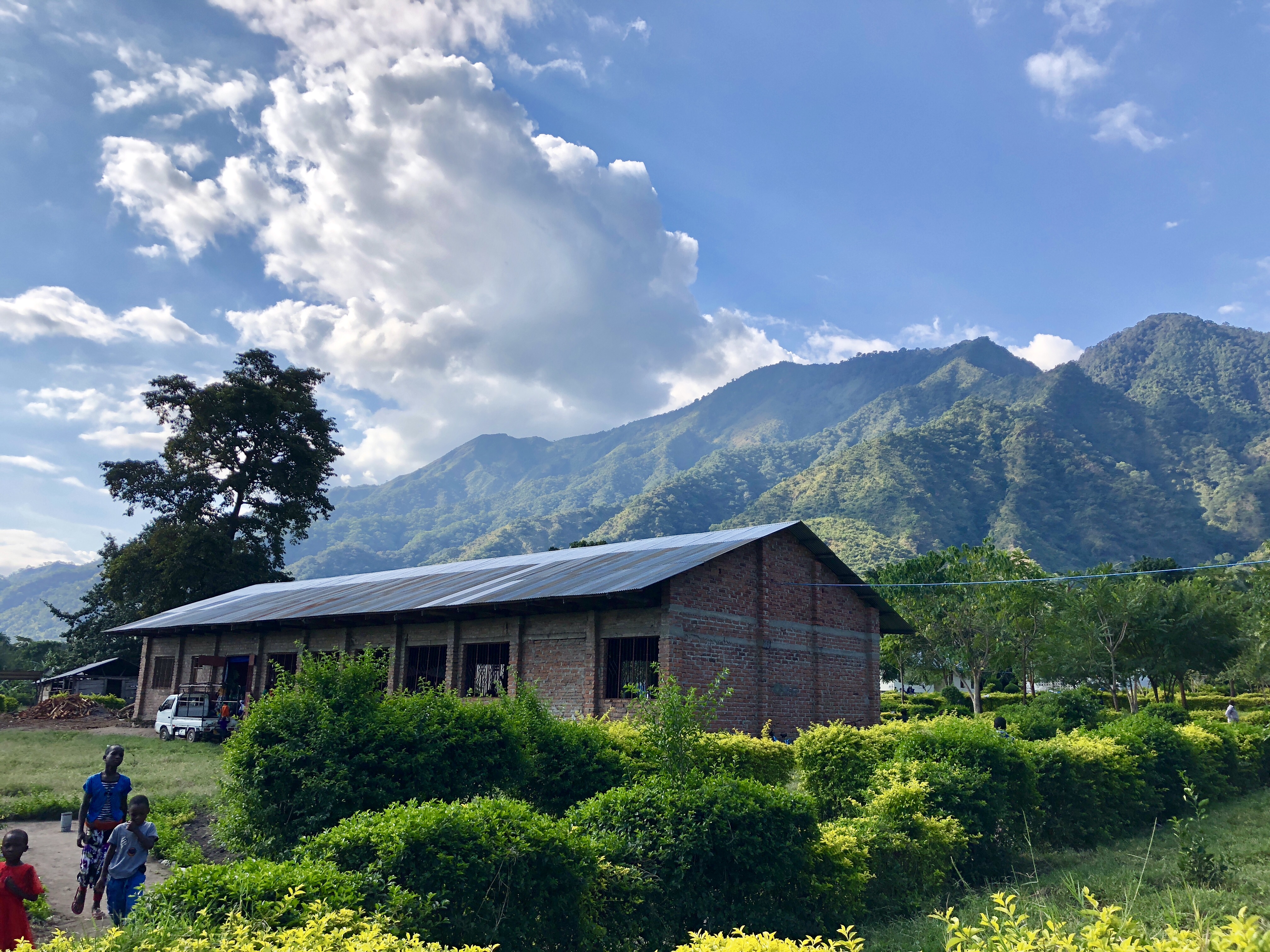
I decided to ask one of my mentors about this anxiety and fear – Mama Mpoki; the chairwoman of the 60 member cocoa bean cooperative we’ve partnered with in remote Tanzania for a decade. She and her husband, Mr. Livingston, live in Mababu, a small village near Lake Nyasa in the foothills of the Livingston mountains. I wanted to ask her about joy amidst sadness without fear. The people in this part of Africa, and their ancestors before them, have lived their lives on the edge. The edge of death by malaria, starvation, HIV/AIDS, to name a few. That does not even cover their days on the edge of life economically. If we dropped you into this spot for an hour or two you’d think “these poor people have nothing” and you’d be oh so wrong. If you stayed for a week you might not want to leave.
Mama Mpoki and her husband Mr. Livingston
I’ve been visiting Mama Mpoki and her cooperative for ten years. We’ve led groups of local high school students to meet her and the farmers. She’s a strong, confident, compassionate, regal, joyful, inspiring, devout leader. I posed my question to her a few days ago on WhatsApp video asking her to illuminate this mystery of joy and sorrow in light of “the Corona” as she called it. As she was gathering her reply she laughed at the question. She’s known me for a long time but still marvels that we would ask such questions with obvious answers.
Mama Mpoki explained it in four parts:
First, we’re born into a life with parents and ancestors who teach us not to fear death. We’re raised to take life as it comes to us.
Second, from a very early age we see our elders live long lives without disease because they eat natural foods. They live into their 90’s or even to 100 years old. If they do get a disease they do not fear death.
Third, we have a personal belief in God and no matter what one day we will die.
Fourth, we live a mutual life encouraging and supporting each other all along the way. We have strong confidence in this. We know as we approach death that we will be lifted up by others. We help each other.
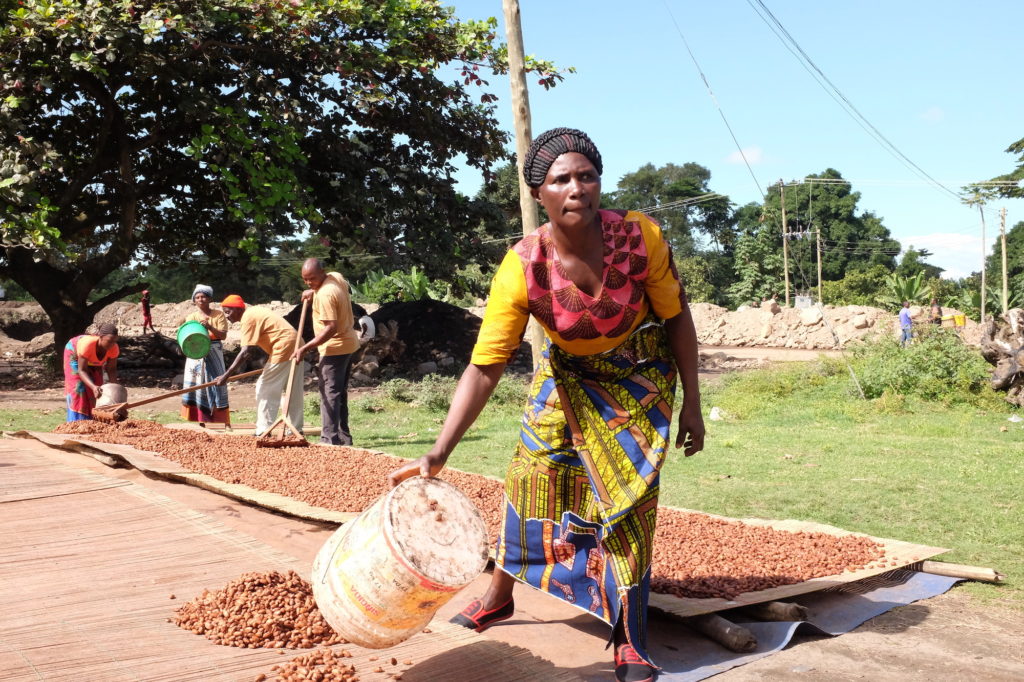
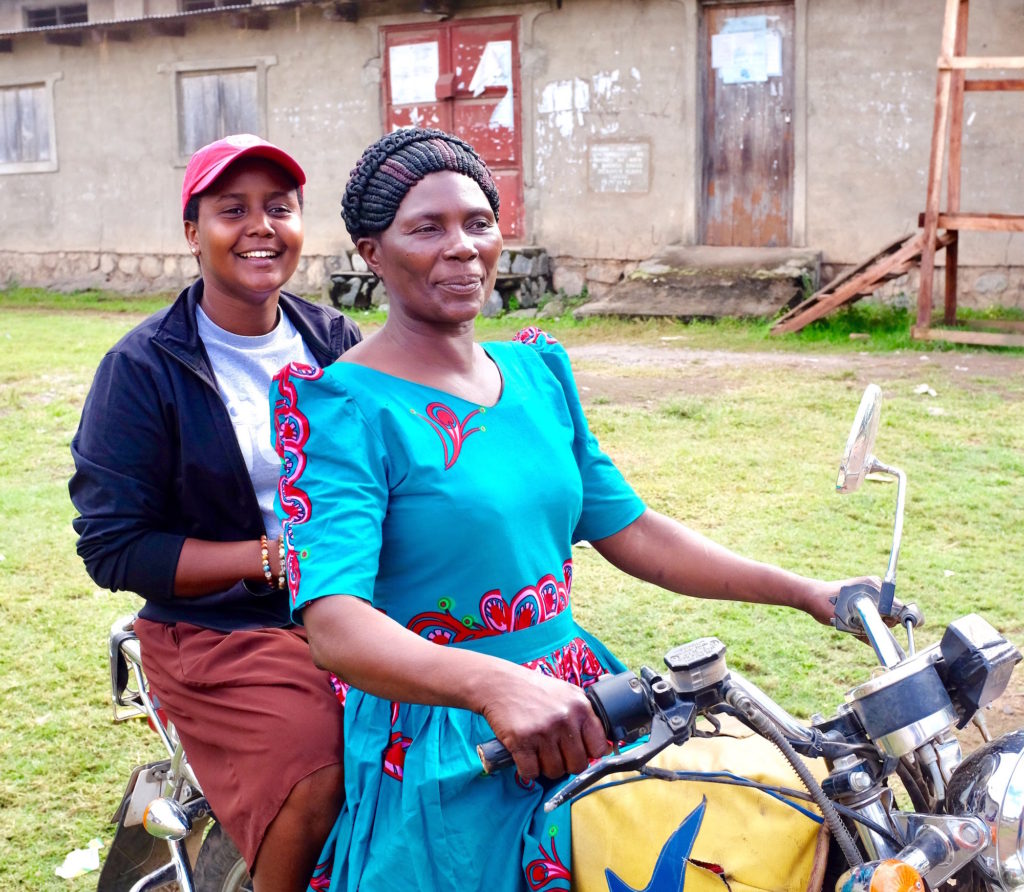
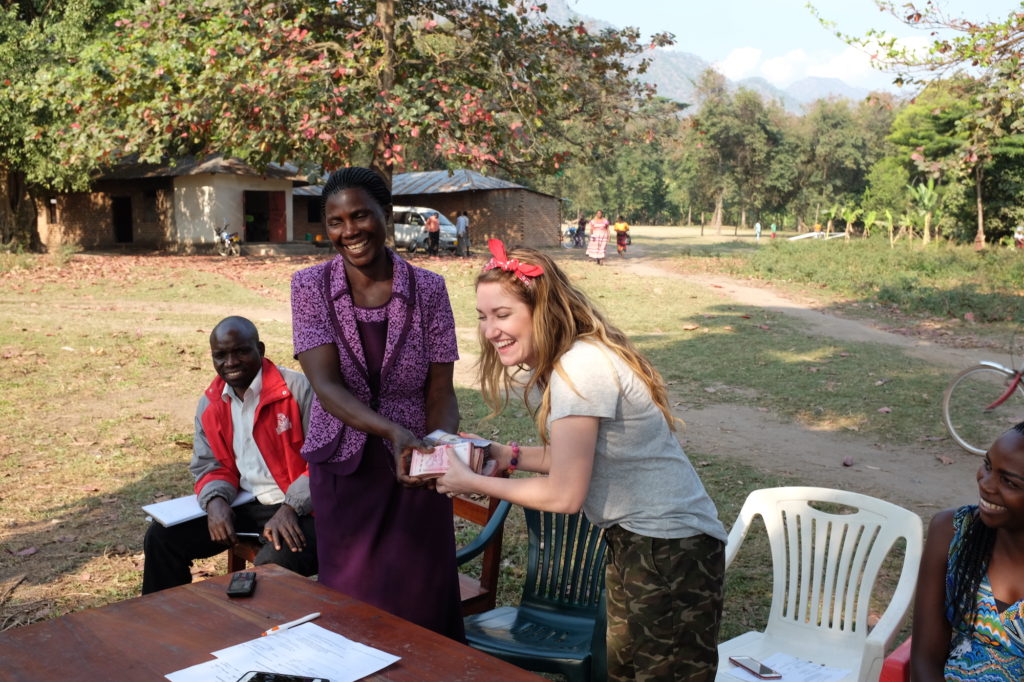
Mama Mpoki drying cocoa beans, riding her motorcycle with Saraphiner, and with Lawren Askinosie during a profit share meeting
I asked what she thought of us right now in fear and panic here in America. She laughed again, maybe a little less this time, and said, “Here in Mababu we’re not scared of the Corona. We’re taking all of the precautions the government tells us. We’re being careful. But we believe that it does not have power over us even if we die.” “Yes but what about us?” I ask. “Well, we think that Americans probably do not eat natural good foods. You’re raised in a rich lifestyle and many of you might not know what it means to live a hard life. You do not have elders to help raise you up. And without a mutual life then who encourages you?”
It’s painfully simple. Yes these could be discounted as sweeping generalizations. Not all is lost for us as a cultural collective. I have long said that the next century will bring African missionaries to our land to teach us how to live, how to worship, how to open our hearts, and how to die. But most importantly they can teach us right now what it means to live in mutuality. In Swahili the word is “kujengana” which means “to build each other up”. I need to let this soak in. Perhaps Mama Mpoki and the farmers can teach me from a distance how to diminish some of my own fear and panic.
If you listened to me play the guitar for 10 seconds you’d think I know what I am doing, at 20 seconds . . . not so much. There’s only so many cool sounding ways to play Smoke On The Water and La Grange. My parents bought me a second hand Gibson LG acoustic guitar when I was 12, the year my dad was diagnosed with cancer. He was sick for a little over two years.
Hard to believe that it’s survived all these years . . .
In September 1975, three months after my dad died, the Ozark Mountain Daredevils released The Car Over The Lake album. I played one song on that record over and over and over to the point that I might have worn it out. The song was “Cobblestone Mountain” written and sung by Steve Cash. It’s a slow and haunting song that is easy to sing along with and I did. Repeatedly. My Magnavox record player with two speakers was perched on my dresser in my bedroom. I’d put the song on, sit on the floor alone, my back against my dresser and could feel the vibrations of the music.
Cobblestone mountain it was made by hand
From the magic and mortar of a cobblestone man
Cobblestone mountain it was laid by hand
From the magic and mortar in a cobblestone land
Magic and mortar in a cobblestone land
I have no idea what the song means but I didn’t need to know. I felt it. I sang it and I learned how to play the C and G chords on my Gibson and played along with it. To me it was a kind of Gregorian Chant. That song, that music, Steve’s voice, my guitar, those two chords, my voice, all contributed in a mysterious way to my healing.
Steve Cash, Ozark Mountain Daredevils. Photo provided by Allison Cash
Dr. Karen Scott, adolescent grief expert and co-founder of Lost & Found Grief Center, says “Music is an avenue to the soul. It touches us in places like nothing else can. This begins when we’re very young. It’s why we use music therapy for grieving children of all ages at Lost & Found.”
My friend, Abby Mercer, music therapy intern, said my experience was not surprising at all:
Music is so effective as a tool for therapy because it is a multi sensory experience. When you listen to music, you are engaging with cognitive, physical, and emotional elements. Music is also an incredibly validating experience for people going through the grieving process. We often connect with sad songs when we are feeling sad because it is validating to know that someone else has had those feelings. Physiologically, music can regulate heartbeat, decrease blood pressure, and increase dopamine in the brain. Making music, whether playing an instrument or singing along to a song in the car, is a very healing experience both emotionally and physically. Music is the only stimulus that activates the entire brain, so it allows us to process emotions more effectively.
Amen Abby! That explains everything. I’ll have some more of that please.
How could I have known back then that one day Steve Cash’s daughter in law, Allison Cash, would become our Chief Operating Officer at Askinosie Chocolate and serve on the board at Chocolate University. A few years ago I was fortunate to have lunch with Steve and thank him with a lump of gratitude in my throat that made it hard to talk. He was so kind. Sadly, Steve Cash died a few weeks ago. I can hope that his family will find a sliver of comfort and peace in the healing music he leaves behind.
I’ve worked with our teen group (those who have experienced the death of a loved one) at Lost & Found for about 8 years as a volunteer group facilitator. I’ve seen the healing power of music first hand. Grief can be gut wrenching hard work. It’s not something that happens to us. It’s something we do. Grief is a language of love that we can learn even though we would have chosen another language to master if given the choice. Music can be a balm for our broken hearts. It was for mine and remains so to this day. I still have that old guitar and occasionally play it just to see if I still know Smoke On The Water and Cobblestone Mountain.
My advice: if you know a heartbroken child you might consider buying him or her a guitar this holiday season. It could be just the thing their soul is yearning for. It need not be expensive. Anything that will play a C or a G will do.
Hint: It’s not about the chocolate, it’s about the chocolate.
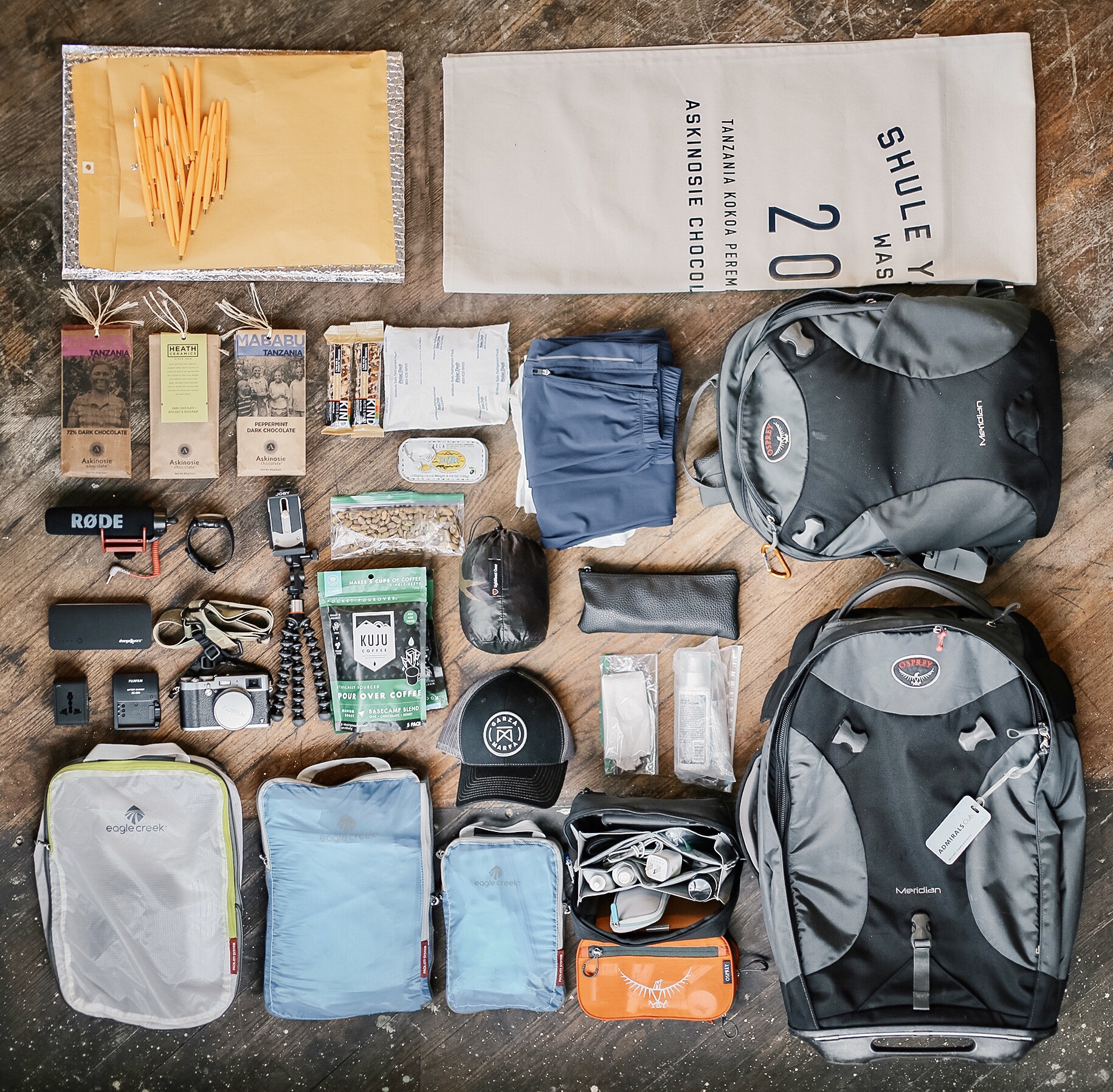
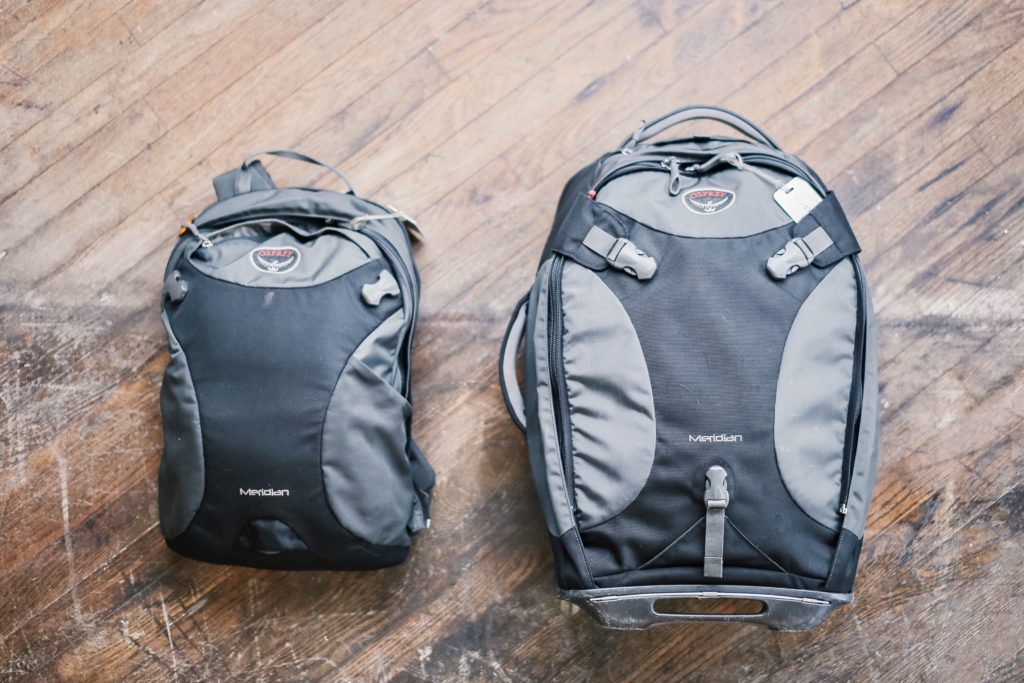
You’re looking at my organized mess for origin trip #44 to Tanzania. Lawren and I are departing tomorrow. My number one rule is that everything must fit in a carry-on. Period. I stopped checking bags in 2006 when mine were lost somewhere in Tapachula, Mexico. I have used an Osprey roller bag with a daypack attachment for many years. What’s great about this bag is that it fits in the overhead, has backpack straps in case I need them and the best thing is that I can attach my daypack to it and relieve my shoulders walking miles through an airport.
All of my origin trips are near the equator, hot, humid, and often remote. As you can see I take a lot of stuff with me and my tasks are fairly similar on each trip. First, I always bring massive amounts of chocolate for farmers to taste. This week will be enough for 60 farmers. In order to do this I take one frozen polar pack (it’s not liquid when I pass through TSA and I keep it frozen along the way). I use a reflective thermal envelope to keep it cool once I arrive. I take roasted cocoa beans so they can taste our latest roasting profile and see how we try to dial in flavor. Second, I bring profit share documents; essentially our financials and a calculation of the share in English and Swahili (since I will be in Tanzania next week). Third, I always bring gifts for our farmer friends. This time you will see 100 orange pens in the photos imprinted with the farmer coop name and ours. This was Lawren’s great idea and the farmers will love these. We’re also bringing gifts for the Empowered Girls/Enlightened Boys graduating students. We’ve also packed notes from our local middle school summer school students to the kids in our after-school program in the village. The coolest gift is a big banner commemorating our Academy of Chocolate Award for our “Tanzania Peppermint Dark Chocolate”. Every award we win we share with farmers in some way. The farmers will hand this proudly in their office. Another great idea from Lawren, this banner highlights the farmer cooperative and they will love it.
You’ll see I’ve packed a can of my favorite sardines, some pistachios, and not pictured a box of Good & Plenty, and an airplane bottle I filled up with Macallan 12 year old single malt scotch (a Christmas gift from Lawren). Why? Because while I am there I will visit my good friend Mr. Livingston, an elder, cocoa farmer, and husband of the coop leader Mama M’Poki. I will be in his home and I always bring him something special and this time I wanted to share some of my favorite snacks and a sip with them. At first glance they might not be the “perfect pairing” but they are for me and they will be for him too.
Do you see the theme here? I first pack my little suitcase for relationships and everything else comes after that.
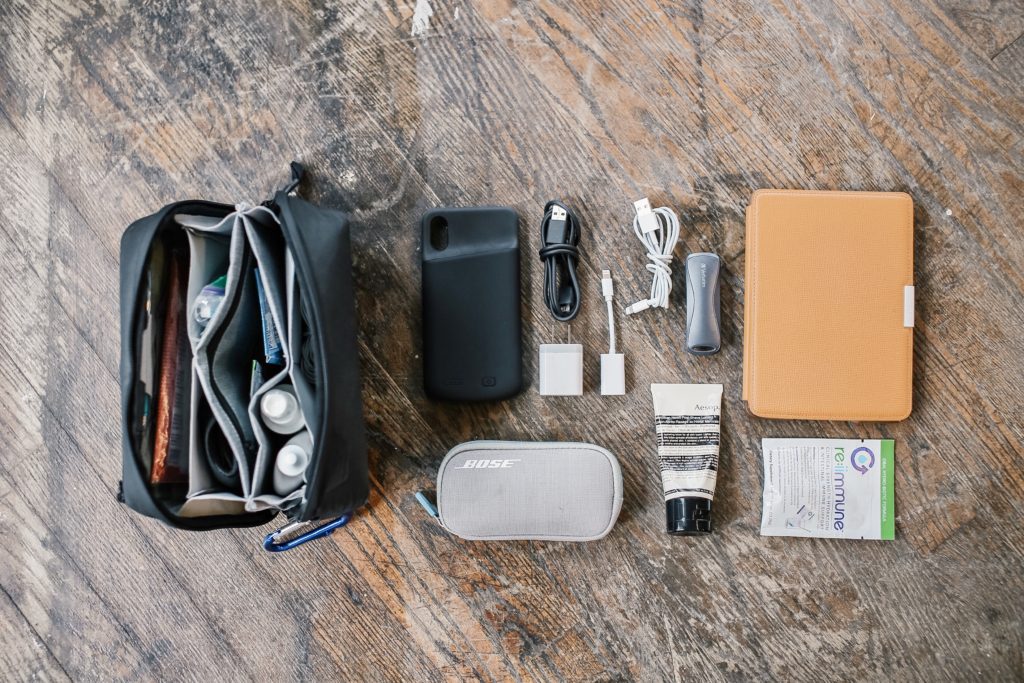
My list below is pretty self-explanatory. Some things require a mention. Since I cannot afford business class tickets — and yes I do covet those seats on transocean flights (more like beds) when I pass by and walk another 30 rows to my seat — I do some things to make my journey a little more comfortable. I spring for the Admirals Club, it’s not inexpensive but a lifesaver on some trips even though I am sick of carrots and humus. My American Express card comes with a Priority Pass membership that gets me in to airport clubs/lounges all over the world. Most of them are about the size of a two bedroom apartment. However, it can be a really nice place to relax on a layover after a 13 hour flight and they might have a hot shower and a comfortable chair. Another thing you might notice in my in my small bag is a tube of Aesop after-shave lotion. I put that stuff on my hands and face mid-flight and it’s super rejuvenating mainly because it smells great. Another luxury is my Bose Noise Canceling headphones which make a huge difference.
I pack a small bag (Peak Design, but could be anything) that holds the main stuff I’ll need in-flight inside my backpack for long flights. I use a carabiner and hang it on the seat back in front of me. It fits inside my daypack and I pull it out as soon as I find my seat and I put everything else in the overhead (my pack attached to the Osprey). Now I have unencumbered floor space and everything I will need for the next 14 hours or so right in front of me.
Without further adieu, here’s my list . . . .
My Packing
List
I use an Osprey carry on with a small backpack attachment.
-GIFTS!
Clothes -I pack all of my clothes in 2 Eagle Creek ultra-light compression cubes. These are a must for me as I would not be able to fit all of this without them. My brother Jason gave these to me several years ago. -2 pairs long pants (lightweight quick dry and a pair of jeans that I wear) -1 nicer long sleeve shirt -1 t-shirt -4 daytime shirts for sun, heat, and humidity -5 pairs of underwear (most places I stay can do laundry) -3 pairs socks -1 pair shoes that I wear. My main requirements: lightweight, durable, lots of arch support, maybe water-resistant. They must be able to take lots of walking, standing, hiking on farms. Lawren swears that bringing an extra pair makes all the difference but I don’t have room. I buy rubber boots for $15 at origin during the rainy season and give them away before I leave. -hat -belt -hoodie/pullover (for plane and nights) -Ultra lightweight raincoat (by LightHeart) -Sleeping sheet insert (in case of a really questionable hotel bed) -Pillow case (see above) -washcloth
Toiletries Bag I keep this packed all of the time -I use the Osprey Ultralight -deodorant, toothpaste, toothbrush, razor -Mosquito repellant -Sunscreen -Shout wipes -Small roll [not the whole thing!] of toilet paper with cardboard out in plastic baggie -shave cream -dental floss -lip balm -razor
Med Bag I keep this packed all of the time -Eagle Creek small compression cube -Malarone – anti-malarial -Imodium -Cipro –Re:iimmune -Benadryl -Ibuprofen/Aleve
Gadget Bag Always packed – Flash drive – iPhone to HDMI adapter – REI Travel Adapter (no longer available) but like this one on Amazon. – Wall charger / 4 USB – Macbook Air charger /cord – extra lightening cord – Bluetooth speaker – USB plus battery – black electrical tape to cover gadget lights – “Polar pack” to keep chocolate cold – Rode VideoMic for iPhone – Rode Lav mic – Fuji X100T camera – Joby GorillaPod Kit tripod
Mini-Bag [Design Peak] (daypack) Always packed -Passport! [make sure more than 6 months before expiration] -Priority Pass Club Card -Yellow Fever Card -Bose noise canceling earbuds -Gum -Protein bars -pens -aspirin -extended iPhone battery case -Kindle + charger -iPhone charger -wallet -eyeshade -ear plugs -iPhone charger plug -Nixall sanitizer -almonds and crackers -Wisps -Aesop after-shave lotion
CASH – personal – profit share – credit card – debit cards – extra credit card
Is there something you can wear or pack that centers you? For me, it’s my Rosary bracelet. When things are going awry on the trip or not working the way I’d planned (frequently) I might take take the bracelet off, hold it, look at it and pray a brief mantra and find my way back. I also use 5 bells that go off on my phone the same times each day and those remind me of a one sentence prayer to say which more often than not brings me back to center “With you, O Christ I live in hope.”
I thought it was important as the CEO/Founder of Askinosie Chocolate to speak up again about this very important issue. Chances are, you’ve seen last week’s viral Washington Post article, “Cocoa’s Child Labors” detailing how much of the world’s commercially produced chocolate is made from child labor (a lot). Sadly, this fact is not new to us. In fact, when I founded Askinosie Chocolate in 2005 I was inspired to base our company on Direct Trade practices specifically to combat the issues of child and slave labor in cocoa.
1.I’ve never seen any evidence of child labor where we source our cocoa beans in 14 years.
A few weeks ago I returned from my 43rd origin trip since founding the company. We currently source our cocoa beans in Tanzania, the Philippines, Ecuador and the Amazon (near the border of Peru and Ecuador). I have been visiting our partner farmers and their farms annually since 2005. Some of our Direct Trade relationships are over a decade long. I can report that I’ve never, not once, seen anything resembling child labor. We’re proud that we can ensure that our chocolate is made without slave labor– child or otherwise. This is Direct Trade, which we’re proud to pioneer in our industry. Lawren Askinosie, our CMO and my daughter, works hard sharing these stories on our website and on all of our social media channels. It’s also worth noting that our farmer cocoa bean contracts prohibit the farmers from using child labor. Could I have missed something? Of course, but over the arc of time in all of these places it is unlikely. Through the years you’ve come to trust us in the same way that I have come to trust our farmer partners when they tell me they do not use child labor.
2. The issue of child labor in cocoa is a subset of a larger farmer economic problem.
I’ve previously written here about the complex web of extreme poverty facing most of the world’s cocoa farmers. Suffice it to say that many cocoa farmers in West Africa (the epicenter of the Washington Post story) are living just above $1 per day. You read that right – one dollar. That is way below the United Nations definition of “extreme poverty” which is $1.25 per day. It is no wonder that cocoa farmers living as modern day slaves “hire” children to work on their land to harvest. The Big Cocoa companies – the ones profiled in the Washington Post article (and others) – can build hospitals and schools in West Africa as consumer facing marketing campaigns but that will not minimize the fact that the price of cocoa has not changed in over 30 years when adjusted for inflation. The price is probably lower now than 30 years ago.
3. We wrote a book detailing our Direct Trade sourcing practices.
I mention this not to sell more books but to say that I’ve spoken, thought and written about the issues of cocoa bean sourcing and supply chain a lot. Lawren does a great job of distilling the tenets here. For brevity the headlines are: (1) we start with excellent cocoa beans of the highest quality, (2) we are financial transparent, open our books, and profit share with farmers, (3) our farmer partners practice sustainability and responsibly farm their crop, (4) we ask our farmers to use socially sound practices like fair wages to laborers and that they use no child or slave labor and (5) we visit our farmer partners annually and have since day one and chronicle each trip.
In practice this might mean something as simple as helping a small farmer group open a bank account at said bank so we can actually wire them money directly. Or it might mean something as complicated as assisting a farmer group in becoming their own exporter thus reducing middle men and women in the supply chain so they can keep more money.
Speaking of money, on average over the last 13 years we’ve paid our farmer partners 55% more than they would have otherwise received at “farm gate.” This is real money. You can read all about it in our Transparency Report. It’s not moving the needle in the world of cocoa but it is a place of beginning. It’s a little lamp that we can shine together.
Why? What’s this all for? It’s the right thing to do and it makes for better tasting chocolate. I could sum it up in two words: mutuality and kinship.
4. We not only pay more for cocoa beans but provide positive opportunities for children where we source our beans.
We sponsor and staff 3 Empowered Girls clubs and 2 Enlightened Boys clubs (which we founded because we could not find one) in Tanzania where we source our cocoa beans. Several thousand young people have graduated from these clubs where we teach life skills, self esteem, visioning, and reproductive education just to name a few topics.
We have a feminine hygiene project in which we provide all of the Empowered Girls club members with pads, underwear and soap so they can attend school during those times. Previously, they had to stay home from school without access to these basic necessities.
We’re building a pre-school right now in Tanzania for 300 little ones because this early childhood education is a vision point for our farmer partners. We’re funding construction and they’re running the school which will be open in January 2020.
We’ve provided over 1.1 million school lunches to malnourished students in Tanzania and the Philippines without any donations, all 100% sustainable through our A Product of Change project. We’re now supplying school lunches to 400 students a day at an elementary school in the Philippines with the sale of Tableya. We monitor height, weight and school attendance.
We founded a program called Chocolate University when we started the company to engage students in our neighborhood. We have an elementary, middle, summer and high school program inspiring young people that business can be a force for good in the world and that there’s a world beyond Springfield, Missouri. The high school program is an intensive business immersion experience for local students that we actually take to Tanzania to meet the farmers we do business with and see how all of this works from a front row seat.
I presented this topic just last week to students in our C.U. summer school program so they can learn the realities of child labor in cocoa farming.
Wish there was something you could do? Luckily, there are dozens of craft chocolate makers whose bars you can purchase to satiate your chocolate fix while also ensuring it was sourced ethically. Vote with your dollars! Demand more of the companies you buy from. We all deserve better, especially the men, women and children on whose backs most of the world’s chocolate is made. From the bottom of our hearts, thank you for taking the time to read this and for caring about where your chocolate comes from. We couldn’t do what we do without your support of our mission.
Want to dig deeper . . .
Learn how you can use the principles of Direct Trade in your business then read our book, Meaningful Work; especially chapter 4.
Watch this Facebook video where I try to explain the nuances of traceability and transparency throughout the cocoa supply chain and why we should think twice before purchasing those $2 chocolate bars. Basically what I’ve attempted to say here above.
Our local NPR affiliate did a nice story you can find here in case you want to listen.
Read my previous post here detailing the income of farmers in West Africa.
Follow the research and advocacy of Cocoa Barometer much of which informs my own understanding of the financial plight of cocoa farmers in West Africa.
Our Coconut Milk Chocolate Bar took home the GOLD this past week! It was chosen by the Specialty Food Association out of thousands of entries from all over the country, across dozens of specialty food categories to receive this prestigious industry award. I am so proud of all of the hard work that went into making this vegan + dairy-free bar. The beans are from Ecuador and my good friend and long time farmer partner Vitaliano and his son Moises. They’re on the front of the bar. I’ve been buying beans from this family for twelve years. I will be visiting them THIS coming week and celebrating this Gold award with the family. We’ve prepared a cool banner for them to hang at their farm. Our crew at Askinosie Chocolate put their hearts and souls into this bar. This chocolate won Silver at the International Chocolate Awards last year, and was a Good Food Award Finalist this year. But the Gold award catapults this chocolate bar into a whole other category.
If memory serves me we won our first Specialty Food Association award – a Silver – in 2008 for a dark chocolate bar made from beans from the same farmer as the Gold from last week.
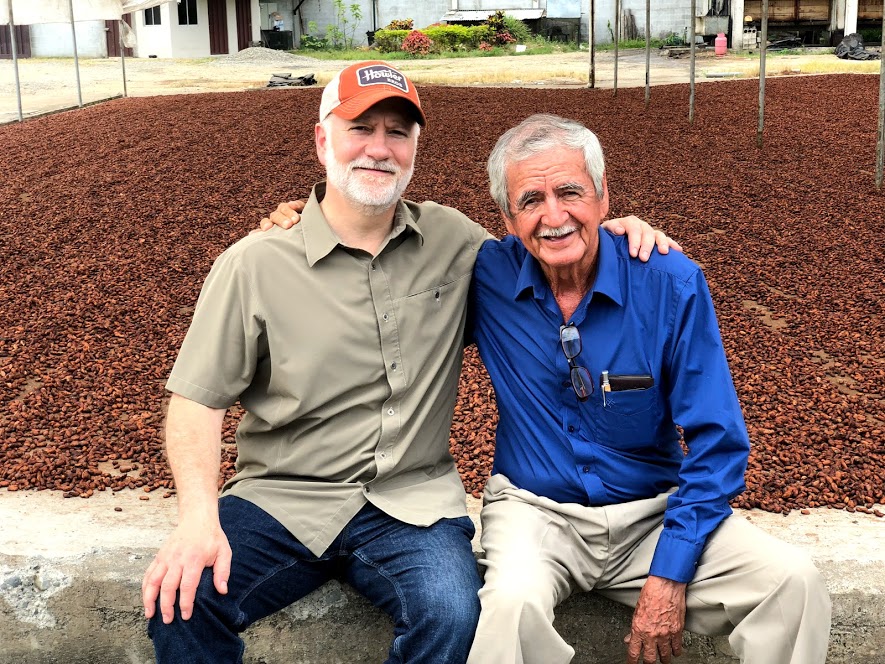
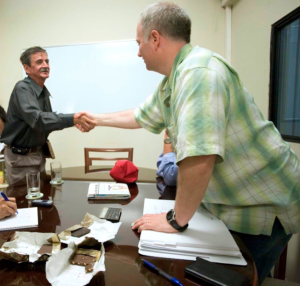
Vitaliano and I shaking hands over cocoa beans 13 years ago this week!
When I started our little chocolate factory over twelve years ago there were two or three of us in the U.S. starting about the same time making bean to bar chocolate. Now there are probably close to 300. That does not include confectioners who make chocolate bars starting with chocolate someone else made. What I am trying to say is that there’s massive competition and many truly great tasting chocolate bars available. Let me suggest two makers in case you’ve not tried something from them yet; Dandelion Chocolate and French Broad Chocolate. You will not be disappointed.
All of the reasons mentioned are alone enough of a reason to be proud of this Gold award. But they’re not the real reason I am over the top excited about this win. The reason is that I always want our chocolate to taste a little bit better than our other vocational work; i.e., working with local students, supporting Empowered Girls/Enlightened Boys programs, funding and supporting school lunch programs. We talk about this a lot in our book, Meaningful Work, but we want you to buy our chocolate because it tastes great. We hope you keep coming back because you connect with us, our story and our work. I have long believed that if we do not focus first on the quality of product and instead rest on you buying our chocolate because you like the story then one day we’d end up with chocolate that tastes like sawdust.
We just broke ground on a pre-school for 300 children in Tanzania in partnership with cocoa farmers we’ve been working with for nearly a decade. Early childhood education in their village was part of their Ten Year Vision Plan we helped facilitate. This is a really big deal. It would be hard to put into words how meaningful this is to us and me personally. We will talk more about this in the coming weeks. I asked myself over the last several months “how will we top that work with our chocolate?” Can our chocolate be “better” than that work? This is what we mean when we write in the book or I say to audiences, “It’s not about the chocolate, it’s about the chocolate.” Both are true in a very non-dual sense. The Gold award validates, for me, the tip top benchmark of quality of our chocolate.
Our Chocolate University Pre-School Day Camp this past summer – a preview of the actual school to come
I am super competitive and want to win all of the contests we enter. But I’ve never looked at it as beating the other chocolate makers. I want to win because I know that if we keep feeding our souls by working with students and farmers then we can never stop trying to make the best tasting chocolate possible. By the way, this philosophy is not exclusive to chocolate. It could be your company and the product and service you make or provide. It’s not about the _________, it’s about the ________!
A couple of weeks ago I bought myself a gift: Paesano bread from my good friends at Zingerman’s Mail Order. I have been enjoying this rare treat immensely, grilled on the Big Green Egg last night and toasted this Labor Day morning. I am reminded of one of my favorite poet philosophers Kahlil Gibran who said, “For if you bake bread with indifference, you bake a bitter bread that feeds but half man’s hunger.” The same is true for chocolate! Or any product or service you provide. Work vocations provide meaning and purpose. Products or services created with intention, by people who feel they’re contributing toward a higher purpose, will undoubtedly be higher quality.
We’ve been working for over two years on one chocolate bar that we will release in mid-September. It’s a collaboration with our friends at Heath Ceramics. They’re a historic, iconic company in the design world. Heath shares similar values to our company. They believe in “human-scale”– they make everything they sell by hand, just like us. Their factory is small and they’re dedicated to true quality and craftsmanship. Their ceramics are most certainly not bitter. Similarly, It took two years to develop this chocolate bar because it needed to be just right. We’re making this chocolate bar with care, not indifference, and thus we aspire to the lofty goal that it feeds not half but “all of man’s [and woman’s] hunger.”
Making something “with care” does not mean the same thing to every employee. For some in our little company it means taking pride in the attention to every detail in the process from roasting the beans to texture of the chocolate. For others it means knowing that cocoa farmers are benefiting from making this chocolate. For others it means having a job. For some it means working with students in our neighborhood. All of the ways we bring care to what we make are inseparable from the finished product. Who we are and how we behave is inextricably linked to our chocolate and the same is true for your product or service.
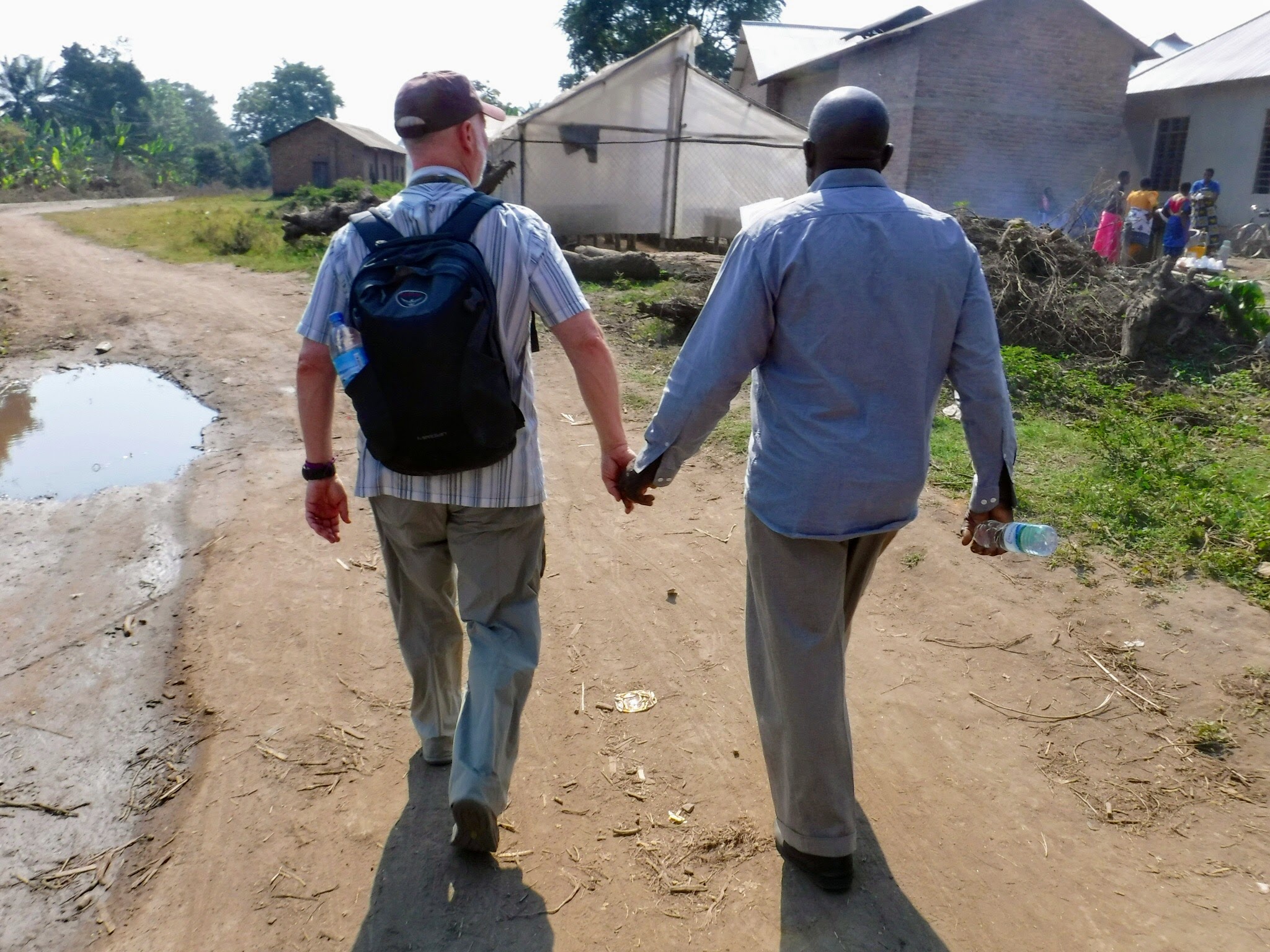
I just returned from leading a group of 15 local high school students to visit cocoa farmers in a remote Tanzanian village on Lake Nyasa in the shadow of the Livingston Mountains. Since 2010 this journey has been part of our Chocolate University program inspiring local students that business can be a force for good in the world. More importantly we give students an opportunity to receive radical hospitality.
On days when I am open and aware I know what it feels like when time stops and I am locked in the present moment. At this point I’ve experienced it enough times to know generally when it’s coming, a kind of warning that I am about to be reminded that I am alive. Usually it’s when I am not expecting it. As strange as it might sound I do not think we choose these moments, they choose us. I’d like to focus on just one from last week.
Nearly every time I’ve traveled to this spot in East Africa I have been a special guest at a graduation ceremony for Empowered Girls and now Enlightened Boys. Last week was no exception. Clocking in at 3 to 4 hours these ceremonies tend to be long by American standards. For some of these young women and men this might be one of the the most memorable days of their lives. It’s a big deal. Side note: we fund and staff Empowered Girls in the region. It was founded and continues to be managed globally by angel on earth Kellen Msseemmaa. We founded, fund and staff Enlightened Boys. Both programs teach self esteem, life skills, sex education and non-violence empowering and enlightening these young Tanzanians for a hopeful future.
Last Sunday afternoon we walked up the foothills about a mile from the village center to the secondary school to attend the graduation ceremony. Nearly 500 students welcomed us with song as our group of American students arrived. We sat at the head tables, adorned with white tablecloths, as the guests of honor. It was hot with zero breeze. There was a meticulously placed bottle of Fanta, Coca-Cola, and water on the table in front of each of us. Lawren spoke on behalf of our group encouraging the young graduates and thanking them for their hard work and dedication. The village students worked hard for weeks in advance of our visit preparing skits and songs to mark the honor of this celebration.
A group of about 30 young women from Matema Secondary moved to the front of this open air oversized classroom to sing a tribal welcome song in their native Nyakyusa dialect. It was a hauntingly beautiful call and response. I had literally no idea what they were saying but I did not need to know. That’s when it happened. Rapture. Time stopped. I did not need to speak Nyakyusa to know that God was speaking. Overwhelmed. What did He say? I have no idea. He was not speaking “to” me. I was an observer, a listener. I videoed part of the song and have played it at least 100 times since that day. Listening to the song over and over brings me right back to that place. I cannot even talk about it without becoming emotional. For a few days I struggled with why? I’ve been to many graduation ceremonies where songs and skits were performed. Why this celebration? Why this song? I don’t know. It doesn’t matter. I am aware of my limitations as a writer. Words are not available to me to describe what happened. In fact, my words are unimportant and I take comfort in that.
I quote Joseph Campbell in my book and he’s an expert on this topic so I’ll bring him into this conversation. He recounted to Bill Moyers in the now famous PBS interview series:
“My friend Heinrich Zimmer of years ago used to say, ‘The best things can’t be told,’ because they transcend thought. ‘The second best are misunderstood,’ because those are the thoughts that are supposed to refer to that which can’t be thought about, and one gets stuck in the thoughts. ‘The third best are what we talk about.”
Here I am “talking about” this present moment of transcendence that probably only lasted a matter of seconds in reality. You see where my feeble attempt ranks in the order of understanding according to Campbell and I agree. Transcendent experiences remind us of our our true selves, who we are, that we are alive. The practice is not about finding the next transcendent experience. That would be tempting but unsustainable. Instead, it’s about pulling the thread of that experience forward into the stitches of our daily lives. My question now revolves around ways I can integrate that moment into my day.
I can look to Christ’s mother as the role model of integration. After the shepherds came to see her baby in the manger proclaiming the angel’s message “Mary treasured all these things, pondering them in her heart.” That’s enough for me. I treasure that moment of song and will ponder it in my heart for many days to come.
Digging Deeper: Reverse scale makes moments like this possible. I have a sense of what the practice of reverse scale feels like. It’s a practice we can use to discover and stay tethered to our true selves in life and business. For me it means that I led this trip with the students when I could have delegated it to someone else. Not scale but reverse scale which can also be called human scale. Read more about priming the pump of reverse scale in your life in Chapter 5 of my book.
We leave in three days for rural Tanzania with 14 local high school students in tow. They’re an elite group of students who competed to be part of our Chocolate University high school program. We launched the project in 2009 and have been taking students to Tanzania ever since. Hold that thought.
We write about reverse scale extensively in the book. What is it? It’s a practice of recognizing the value of not scaling. One of our beliefs, coined by Lawren, is that our vocation is not necessarily getting bigger but getting better at staying small. We’re conditioned by our business culture to believe that unless the idea is big and capable of rapid scale then it has little value. Can we take a step back and reconsider this dogma? Could we assess value even if our idea helps only one person or if it only transforms us? True sustainability lies within the answers to these questions. If more of us answered the call to action on the supposedly “small” ideas then imagine the kind of social problems the world could address.
We tend to think “more” and “bigger” will always be better, that somehow they will allow us to finally breathe easier when we arrive. The problem is that it’s often an illusion because we never really arrive at the place that’s just out of reach. Scale demands that every single person in the chain focus on what’s next and on finding someone to do the thing that’s now ‘below’ them in order to move themselves up. Anything less than that and you will lose the race for scale, because someone else is more focused than you.
Reverse scale could also be called human scale. It is in the smallness of one on one relationships that we find meaning because we’re not insulated from the pain and sorrows of these connections. We tend to lose this when we’re so focused on scale and growth.
Could we have scaled Chocolate University nationwide or worldwide by now? Probably. Perhaps I’d be managing (not leading) multiple trips a year with students from around the world to more than one destination. It would be possible to do that right alongside accelerated growth of my chocolate company. That’s scale! Reverse scale, on the other hand, says, “This is it.” Today, right here, right now. This student, this cocoa farmer, this meal, this village. That’s all I really possess. There’s a lot of power in that. I know I’d lose these important human connections if I were managing, delegating, and looking at spreadsheets instead of practicing this discipline of reverse scale. It is this practice that allows me, at times, to experience my True Self as Thomas Merton calls it.
Back to the high school students I’ll be traveling with on Monday. When we arrive in remote rural Tanzania our students will be embraced by the village farmers as “members of the family” because we’ve been their partners for nearly a decade. We have a packed schedule of “doing” but have left ample time for “being.” In the coming days I will remain a student too as we’re welcomed by farmers who practice radical hospitality.